
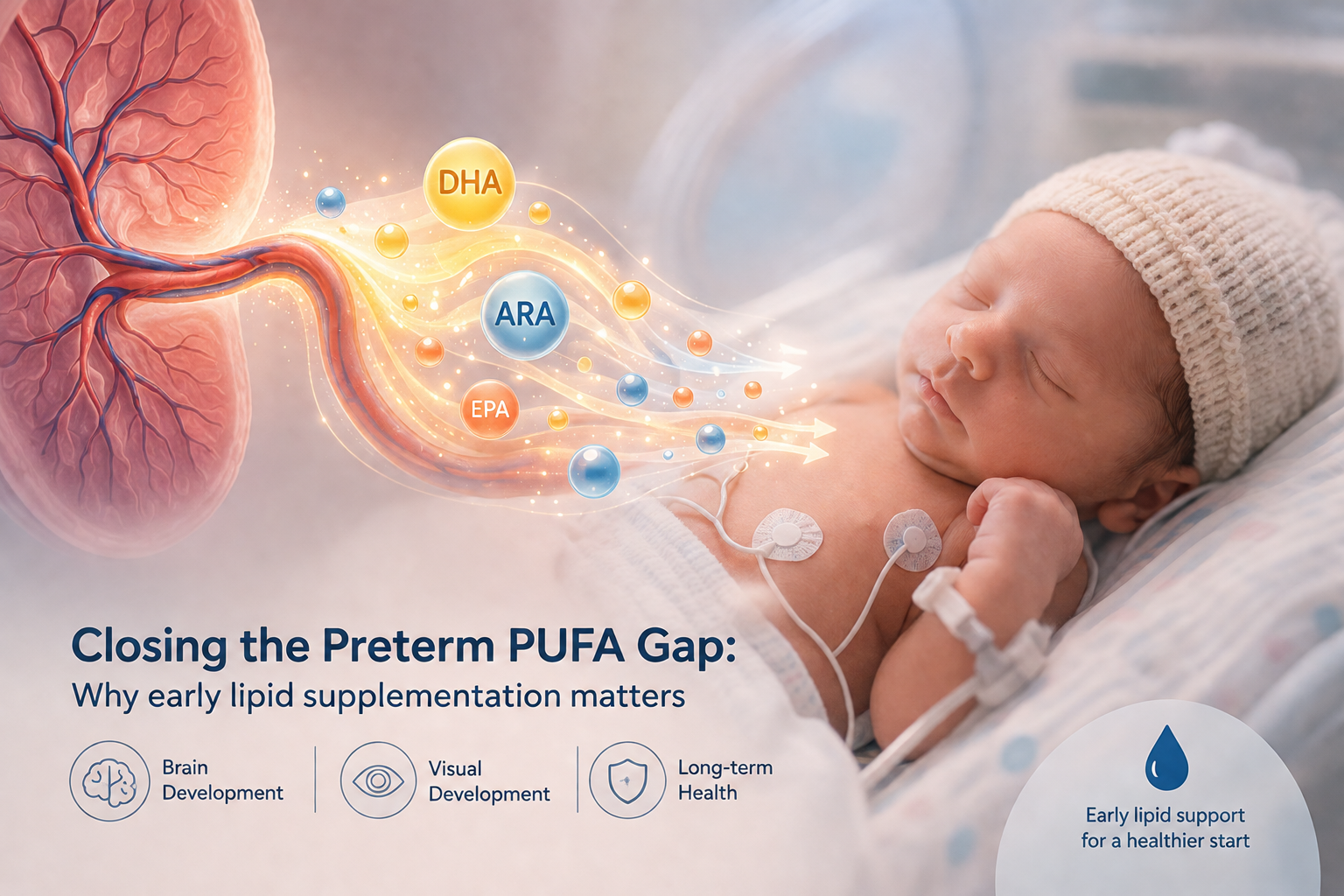
Polyunsaturated fatty acids (PUFAs) play a critical role in early development. Docosahexaenoic acid (DHA) and arachidonic acid (ARA) are key structural components of neuronal membranes in the brain and retina. In the retina, DHA accounts for up to 90% of PUFAs, especially in the rod outer segment.1 DHA is essential for the biogenesis, function, and survival of photoreceptors and enhances membrane flexibility. ARA is distributed more broadly across neuronal and vascular compartments of the retina and is a key precursor of bioactive lipid mediators. These mediators contribute to neurovascular coupling in the retina, regulate inflammatory responses and angiogenesis, and mediate blood vessel relaxation and contraction.2
During the third trimester in the womb, ARA and DHA are selectively transferred from mother to fetus. Interestingly, when maternal DHA levels are low, the fetus maintains higher circulating levels of both ARA and DHA compared with the mother. This phenomenon, known as “biomagnification”,3 and underscores the importance of these nutrients in early development. Fetal accretion rates during this period are approximately 200 mg/kg/day for ARA and 45 mg/kg/day for DHA.4 Meanwhile, their shorter-chain precursors, including α-linolenic acid (ALA) and linoleic acid (LA), are selectively bioreduced.3
Preterm infants miss out on placental transfer during the third trimester and have very limited fatty acid storage in adipose tissue. In principle, ARA and DHA can be synthesized by the body from LA and ALA, respectively. Although preterm infants are capable of this metabolic conversion,5 this is inadequate to fulfil their metabolic needs. In addition, the immaturity of the gastrointestinal tract and susceptibility to illness further limits fat absorption. This all makes preterm-born infants reliant on ARA and DHA intake via their diet.
In February 2026, Dyall et al.6 introduced the term ‘Preterm PUFA Gap’ to describe the decrease in ARA and DHA levels, and concomitant increases in LA, after preterm birth. Current enteral and parenteral nutrition practices provide insufficient DHA and ARA and excess LA, diverging markedly from intrauterine accretion rates. Therefore, preterm infants can develop essential fatty acid deficiencies in less than a week,7 with those being born the earliest at greatest risk for LC-PUFA deficiency.8 This phenomenon may contribute significantly to an increased risk of prematurity-related comorbidities, including Retinopathy of Prematurity.6,9,10
Dyall et al.6 finalize their review with several clinical recommendations to close the Preterm PUFA Gap. Besides early provision of fresh human milk, enteral supplementation with DHA and ARA should be considered. Based on current clinical guidelines,11 they recommend a dosage of 50-65 mg/kg/day DHA and 100-120 mg/kg/day ARA. As shown in previous trials, such supplementation strategies can support brain development and reduce the risk of severe retinopathy of prematurity, without safety concerns.12,13
References
1. Jeffrey BG, Weisinger HS, Neuringerc M, Mitchell DC. The Role of Docosahexaenoic Acid in Retinal Function. Lipids 2001;36(9).
2. Bogatcheva NV, Sergeeva MG, Dudek SM, Verin AD. Arachidonic acid cascade in endothelial pathobiology. Microvasc Res 2005;69(3):107–27. DOI: 10.1016/j.mvr.2005.01.007.
3. Al Sinani M, Johnson M, Crawford M, Al Maqbali M. Arachidonic acid is preferentially biomagnified over DHA in fetal erythrocytes: evidence from 172 paired maternal-cord samples in Oman. Prostaglandins Leukot Essent Fatty Acids 2026;208:102726. DOI: 10.1016/j.plefa.2026.102726.
4. Lapillonne A, Jensen CL. Reevaluation of the DHA requirement for the premature infant. Prostaglandins Leukot Essent Fatty Acids 2009;81(2-3):143–50. DOI: 10.1016/j.plefa.2009.05.014.
5. Carnielli VP, Wattimena IJL, Luijendijk IHT, Boerlage A, Degenhart HJ, Sauer PJJ. The Very Low Birth Weight Premature Infant Is Capable of Synthesizing Arachidonic and Docosahexaenoic Acids from Linoleic and Linolenic Acids. Pediatr Res 1996;40:169–174.
6. Dyall SC, Brenna JT, Carlson SE, Crawford MA, Martin CR, Salem N, Jr. Omega-3 and omega-6 polyunsaturated fatty acids in neurodevelopment and prematurity: Correcting imbalances and closing the Preterm PUFA Gap. Prog Lipid Res 2026;101:101379. DOI: 10.1016/j.plipres.2026.101379.
7. De Rooy L, Hamdallah H, Dyall SC. Extremely preterm infants receiving standard care receive very low levels of arachidonic and docosahexaenoic acids. Clinical Nutrition 2017;36(6):1593–1600.
8. Baack ML, Puumala SE, Messier SE, Pritchett DK, Harris WS. What is the relationship between gestational age and docosahexaenoic acid (DHA) and arachidonic acid (ARA) levels? Prostaglandins Leukot Essent Fatty Acids 2015;100:5–11. DOI: 10.1016/j.plefa.2015.05.003.
9. Fu Z, Yan W, Chen CT, et al. Omega-3/Omega-6 Long-Chain Fatty Acid Imbalance in Phase I Retinopathy of Prematurity. Nutrients 2022;14(7). DOI: 10.3390/nu14071333.
10. Lofqvist CA, Najm S, Hellgren G, et al. Association of Retinopathy of Prematurity With Low Levels of Arachidonic Acid: A Secondary Analysis of a Randomized Clinical Trial. JAMA Ophthalmol 2018;136(3):271–277. DOI: 10.1001/jamaophthalmol.2017.6658.
11. Embleton ND, Jennifer Moltu S, Lapillonne A, et al. Enteral Nutrition in Preterm Infants (2022): A Position Paper From the ESPGHAN Committee on Nutrition and Invited Experts. J Pediatr Gastroenterol Nutr 2023;76(2):248–268. DOI: 10.1097/MPG.0000000000003642.
12. Hellstrom A, Nilsson AK, Wackernagel D, et al. Effect of Enteral Lipid Supplement on Severe Retinopathy of Prematurity: A Randomized Clinical Trial. JAMA Pediatr 2021;175(4):359–367. DOI: 10.1001/jamapediatrics.2020.5653.
13. Moltu SJ, Nordvik T, Rossholt ME, et al. Arachidonic and docosahexaenoic acid supplementation and brain maturation in preterm infants; a double blind RCT. Clin Nutr 2024;43(1):176–186. DOI: 10.1016/j.clnu.2023.11.037.
Reply